

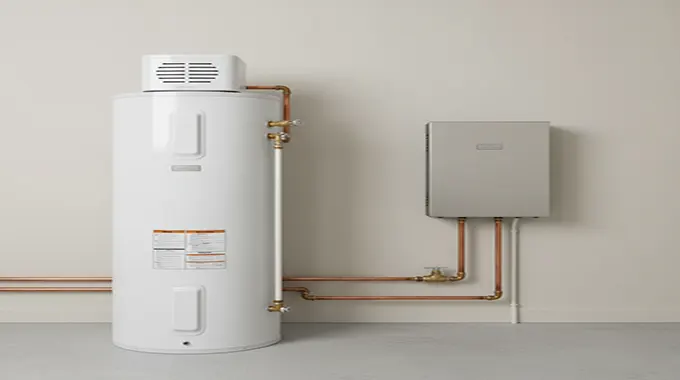
When upgrading to a high-efficiency water heater, homeowners often face a choice between two powerhouse technologies: the ENERGY STAR certified heat pump water heater (HPWH) and the tankless (or on-demand) water heater. Both offer significant energy savings compared to traditional electric tanks, but they achieve their efficiency in fundamentally different ways, leading to distinct performance reviews and suitability for different homes.
Efficiency: The HPWH Advantage
The most consistent finding in reviews is the superior energy efficiency of the heat pump model.
- Heat Pump Water Heaters (HPWH): These units function like a reverse refrigerator, pulling heat from the surrounding air (even in a basement or garage) and transferring it to the water in the storage tank. Because they move heat rather than generate it, they are incredibly efficient—often reviewed as being two to three times more efficient than conventional electric resistance heaters.
- Uniform Energy Factor (UEF) Score: HPWHs typically boast UEF ratings well above 3.0, reflecting their minimal energy use. ENERGY STAR certified models are the gold standard here, offering the greatest operational cost savings.
- Tankless Water Heaters: These units eliminate standby heat loss by only heating water as it passes through the system (on demand). This is a big step up from traditional tanks. However, because they must use high-powered electric resistance or gas to create heat instantly, their energy consumption while running is high.
- UEF Score: Electric tankless models generally have UEFs close to 1.0. Gas tankless units are more efficient than their electric counterparts, but HPWHs still win on pure electrical efficiency metrics.
Review Consensus: If the single most important factor is lowest long-term operating cost and energy consumption, the HPWH is the clear winner.
Performance and Lifestyle Match
Reviews highlight that the choice often comes down to how you use hot water and your home’s setup.
| Feature | HPWH (Hybrid) | Tankless (On-Demand) |
| Hot Water Supply | Limited by tank size; excellent for simultaneous use (e.g., shower + dishwasher). | Continuous/Endless hot water; flow rate can be limited if multiple fixtures run at once. |
| Recovery Time | Slower than traditional tanks or tankless; requires proper sizing to avoid running out. | Very fast; provides instant hot water. |
| Space | Requires a dedicated tank space (e.g., basement, garage) and needs surrounding clearance for air circulation. | Compact, wall-mounted; ideal for small spaces. |
| Climate Performance | Performance and efficiency decline in very cold environments (below $40^\circ\text{F}$/$4^\circ\text{C}$). | Not affected by ambient temperature. |
Review Consensus: HPWHs are better for large families or homes with simultaneous hot water demand, provided they are installed in a mild climate or conditioned space. Tankless units are perfect for small homes or situations where you prioritize endless hot water for one fixture at a time.
Cost and Installation
- Upfront Cost: Tankless units often have the highest overall installation cost due to potential requirements for new high-amperage electrical lines or large gas line modifications and dedicated venting. HPWHs are generally more affordable to install, often using existing electrical connections.
- Lifespan & Maintenance: Tankless units boast a longer lifespan (up to 20 years) with proper annual descaling, while HPWHs typically last 10-15 years. However, HPWHs often come with generous federal tax credits and local utility rebates, significantly lowering the net cost.
Ultimately, reviews show that both are superior alternatives to conventional tanks. The ENERGY STAR HPWH offers maximum energy savings and cost-effectiveness over time, while the tankless offers space-saving design and guaranteed endless hot water flow (within its flow capacity limits).