
For decades, solar energy generation in commercial and residential architecture has relied on a bolted-on approach. Traditional photovoltaic panels installed on rooftops certainly help reduce grid reliance, but they often compromise architectural aesthetics, occupy limited roof space, and remain completely disconnected from the actual structural envelope of the building. In dense urban environments where high-rise developments have minimal roof area relative to their massive vertical facades, rooftop solar alone falls short of achieving true net-zero performance.
As international building codes tighten and carbon reduction mandates become law, architecture is undergoing a profound material transformation. The integration of building integrated photovoltaics and solar green building products represents a revolutionary shift, turning passive building skins into active, power-generating assets that redefine the future of sustainable real estate.
The Evolution from Add-On Solar to Envelope Integration
To understand why building-integrated photovoltaics (BIPV) are reshaping modern construction, we must examine the spatial limitations of legacy solar systems. Traditional rack-mounted panels add dead load to roofs, require separate weatherproofing penetrations, and do nothing to offset the massive energy footprint of a building’s walls and windows.
BIPV eliminates the boundary between construction materials and energy generation. Instead of mounting panels onto a building, BIPV products become the building. By embedding solar cells directly into glass, siding, roofing, and shading systems, architects can utilize every square inch of a structure’s exterior exposed to sunlight, maximizing energy yield without sacrificing aesthetic integrity.
Core BIPV Technologies and Solar Building Products
Innovations in materials science and thin-film solar technology have introduced a diverse array of high-performance solar green building products:
1. Solar Glass and Photovoltaic Glazing
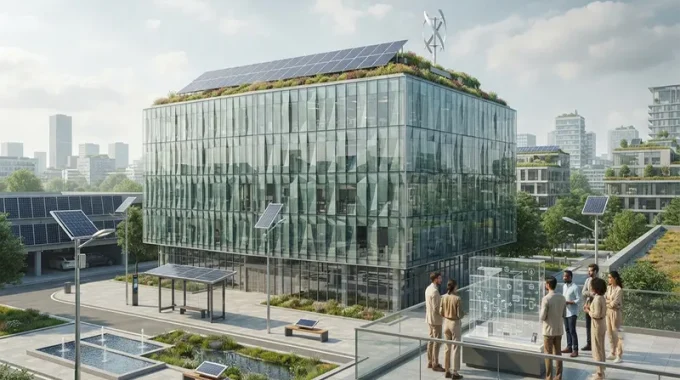
Windows and glass curtain walls cover vast expanses of modern commercial skyscrapers. Transparent and semi-transparent solar glass replaces standard architectural glazing, absorbing infrared and ultraviolet light to generate electricity while allowing visible light to pass through. These advanced IGUs (Insulated Glass Units) simultaneously manage solar heat gain, reduce indoor cooling loads, and harvest clean electricity.
2. Solar Façade Cladding Panels
Vertical exterior walls offer massive surface areas for energy capture. Opaque photovoltaic facade panels are now available in a wide spectrum of colors, textures, and ceramic-frit finishes. These panels clip directly onto rain-screen sub-framing systems, protecting the building envelope from wind and rain while silently producing steady baseline power throughout the day.
3. Solar Roofing Membranes and Interlocking Shingles
For low-slope commercial roofs or sloped residential structures, BIPV roofing products replace conventional asphalt or metal membranes entirely. Interlocking solar roof tiles and flexible thin-film standing-seam metal laminates function as durable, watertight weatherproofing barriers while integrating high-efficiency solar cells right into the roof surface.
Key Architectural and Financial Benefits
Specifying building-integrated photovoltaics delivers profound strategic, economic, and operational advantages across a project’s lifecycle:
- Maximized Surface Area Harvest: BIPV unlocks vertical facades and entire building envelopes, multiplying clean energy generation capacity exponentially compared to restricted rooftop layouts.
- Dual-Purpose Material Efficiency: Because BIPV products serve as both the structural weather-barrier skin and the power generator, they offset the material costs of traditional cladding, shortening financial payback periods.
- Compliance with Advanced Green Standards: Utilizing high-performance BIPV systems helps project teams secure maximum points under rigorous sustainability frameworks like LEED v5, significantly boosting asset valuation and ESG compliance.
Design and Engineering Challenges
While BIPV represents the pinnacle of sustainable architecture, deployment requires careful engineering coordination. Design teams must account for shading losses on vertical facades caused by adjacent structures, manage thermal dissipation to ensure optimal photovoltaic efficiency, and coordinate complex electrical wiring layouts during the early framing stages.
Building integrated photovoltaics and solar green building products represent the ultimate evolution of net-zero architecture. By transforming exterior walls, windows, and roofs into active power generators, BIPV bridges the gap between stunning design and aggressive decarbonization. Embracing solar-integrated building products is a vital step toward creating truly resilient, energy-positive structures for the modern world.