
Municipal solid waste streams have grown increasingly complex. Today’s trash cans are filled with an intricate mix of flexible packaging, multi-layer plastics, organic matter, and electronic debris. For decades, sorting this diverse material stream relied heavily on manual labor or rudimentary mechanical screens. As global recycling standards tighten and commodity buyers demand near-perfect material purity, legacy facilities are hitting a wall.
The answer to this escalating crisis lies at the intersection of computer science and heavy industrial automation. The deployment of ai optical sorting robotics in modern waste management technology is completely revolutionizing material recovery facilities (MRFs), replacing human fatigue with lightning-fast machine intelligence and transforming waste management into a high-precision science.
The Bottlenecks of Legacy Material Recovery Facilities (MRFs)
To understand why robotic sorting is a generational leap forward, one must examine the severe limitations of traditional MRFs. Historically, manual sorting lines have been the backbone of recycling operations. Human workers stand along high-speed conveyor belts, manually pulling cardboard, plastics, and metals.
This model is fraught with challenges. Human sorters suffer from physical fatigue, experience high turnover rates, and face constant exposure to sharp objects, biohazards, and toxic dust. Furthermore, manual lines are slow, struggle to keep pace with modern municipal waste volumes, and frequently allow high contamination rates. When recycled bales are heavily contaminated, entire shipments are rejected by global markets and diverted straight to landfills.
Core Technology Stack: How AI Optical Sorting Works
Modern AI sorting systems are marvels of integrated engineering, combining advanced optics, machine learning, and high-speed pneumatics to execute thousands of complex decisions per minute:
1. Advanced Machine Vision and Multispectral Imaging
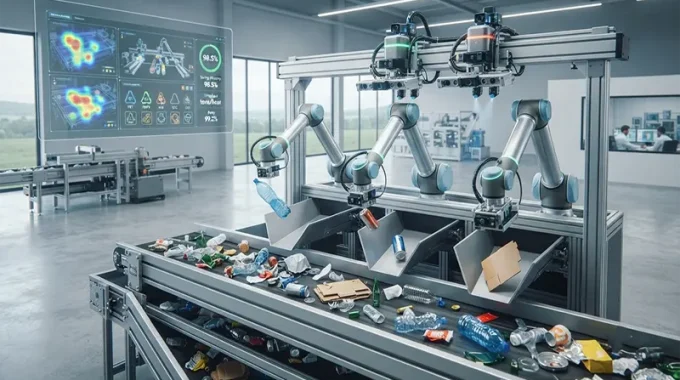
Robotic sorting begins with perception. Above high-speed conveyor belts, sophisticated imaging arrays—incorporating high-definition RGB cameras, near-infrared (NIR) spectroscopy, and hyperspectral sensors—scan incoming material in milliseconds. While human eyes see only color and shape, NIR sensors detect the specific light wavelengths reflected by different polymers, instantly differentiating between PET, HDPE, PVC, and bioplastics.
2. Deep Learning Neural Networks
Raw optical data is instantly processed by deep learning neural networks. Trained on millions of images of crushed, dirty, crumpled, and misshapen waste items, these AI algorithms can identify specific brand logos, material types, and contamination instances in real time. Unlike rigid rule-based programming, these neural networks continuously learn and adapt as new packaging formats enter the waste stream.
3. High-Speed Robotic Actuators and Air Jets
Once the AI identifies a target object, it calculates its exact coordinates, velocity, and trajectory on the belt. It then commands either a bank of precision pneumatic air-jet valves to blast the item into a designated bin or deploys high-speed delta pick-and-place robots equipped with custom grippers to physically snatch items out of the stream with pinpoint accuracy.
Key Operational and Economic Benefits for Facilities
Integrating AI optical sorting robotics into municipal and commercial recovery facilities delivers compounding advantages across economics and operations:
- Radical Purity Improvements: AI-driven systems achieve commodity purity levels exceeding 99%, allowing facilities to produce premium-grade bales that command top-dollar value in secondary raw material markets.
- Maximized Throughput and Continuous Operations: Robotic sorters can operate 24 hours a day, 7 days a week at speeds far surpassing human capability, dramatically increasing overall facility throughput while virtually eliminating labor shortages.
- Data-Driven Plant Intelligence: Beyond sorting, these systems act as data collection hubs, providing facility managers with real-time analytics on waste stream composition, incoming brand volumes, and operational efficiency metrics.
Integration Challenges and Scalability Considerations
Despite their transformative advantages, deploying robotics in harsh industrial environments requires careful engineering. Retrofitting legacy facilities with robotic gantries often requires structural modifications and downtime. Furthermore, continuous dust, moisture, and vibration demand ruggedized optical housings, automated lens-cleaning mechanisms, and high initial capital expenditures that require robust long-term financial modeling.
AI optical sorting robotics represent the undisputed backbone of modern waste management infrastructure. By merging advanced computer vision with high-speed industrial automation, the recycling industry is overcoming its most stubborn historical bottlenecks. Investing in autonomous sorting technology is no longer just an operational upgrade—it is an essential strategic requirement for building efficient, profitable, and truly circular municipal economies.