
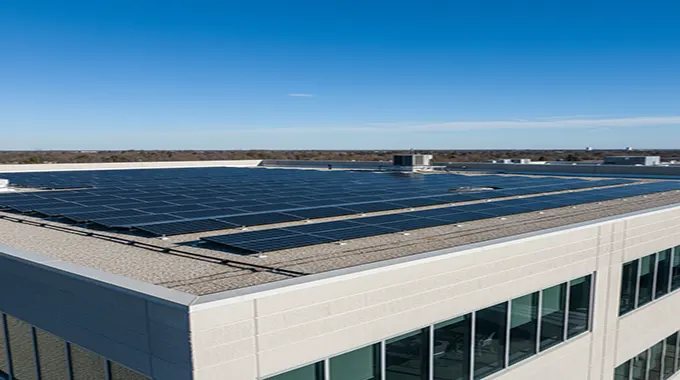
Investing in a commercial rooftop solar system is one of the most impactful decisions a small business can make, offering significant long-term savings and environmental benefits. However, the initial financial outlay is often the first and biggest hurdle. Understanding the cost of commercial rooftop solar panel installation for small businesses requires looking beyond a single price tag to the factors that determine the final investment.
The Average Cost Per Watt
Commercial solar installations are typically priced on a dollars-per-watt ($/W) basis, which accounts for the system’s size (its power generation capacity in kilowatts, kW).
For small to medium-sized commercial systems (ranging from about 25 kW to 100 kW), the average national price before incentives typically falls between $1.80 and $3.50 per watt.
This translates to the following estimated upfront costs for common small business system sizes:
| System Size (kW) | Estimated Cost Range (Before Incentives) |
| 25 kW (Small Office/Retail) | $45,000 to $87,500 |
| 50 kW (Medium Office/Warehouse) | $90,000 to $175,000 |
Crucially, commercial installations benefit from significant economies of scale; larger systems generally have a lower cost per watt than smaller ones, spreading fixed costs (like permitting and engineering) over more panels.
Key Factors Driving the Cost
The final price tag for your specific small business will be influenced by several critical factors:
- System Size and Energy Usage: The primary cost driver is the amount of electricity your business consumes. A higher energy need requires a larger, more expensive system.
- Equipment Quality: High-efficiency monocrystalline panels cost more than standard polycrystalline panels but require less roof space to generate the same amount of power, which can be valuable for small rooftops. Inverters (which convert solar power into usable AC electricity) also vary in price based on type (string vs. microinverters) and quality.
- Installation Complexity: The condition and type of your roof (flat vs. pitched), the need for structural reinforcements, and the distance to the main electrical interconnection point can add to labor and materials costs.
- Location and Permitting: Local labor rates, permitting fees, and utility interconnection charges vary significantly by region and can represent a substantial portion of the soft costs (non-hardware expenses).
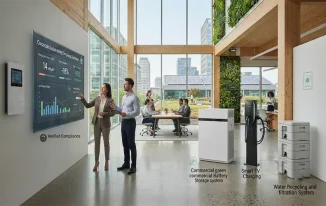
- Battery Storage: Adding a commercial battery system for backup power or to reduce peak utility demand charges (a common strategy for businesses) can increase the initial cost by $15,000 or more, but the long-term savings often justify this investment.
The Power of Incentives
The high upfront costs are significantly offset by various government incentives, which drastically improve the project’s Return on Investment (ROI) and lower the effective cost.
- Federal Investment Tax Credit (ITC): This allows businesses to deduct a substantial percentage (currently 30%) of the system cost from their federal taxes.
- Accelerated Depreciation (MACRS): The Modified Accelerated Cost Recovery System allows businesses to depreciate the cost of the solar equipment over a shorter period (five years), providing a significant tax benefit.
- State and Local Rebates/SRECs: Many states and local utilities offer additional rebates, grants, or Solar Renewable Energy Credits (SRECs), further reducing the overall investment.
After applying these incentives, the net cost per watt for a commercial system can often be reduced to between $1.20 and $1.75 per watt. By thoroughly investigating available incentives and getting quotes from multiple qualified commercial solar installers, small businesses can turn the initial installation cost into a powerful investment in their long-term financial stability.