

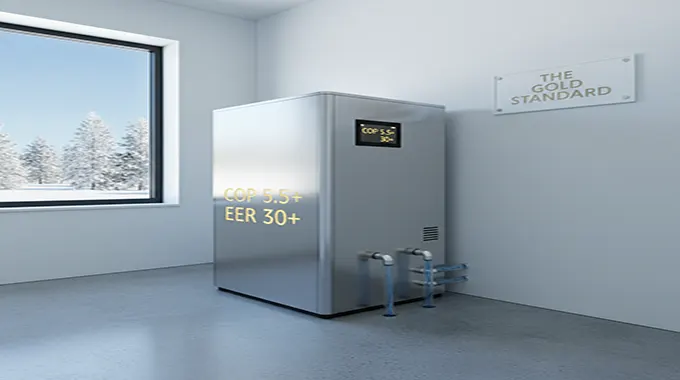
Geothermal heat pumps (GHPs), also known as ground-source heat pumps (GSHPs), are universally recognized as the most efficient heating and cooling technology available, especially in cold climates. Unlike air-source heat pumps, which struggle to extract heat from frigid outdoor air, GHPs rely on the stable, consistent temperature of the earth below the frost line—typically between $50^\circ\text{F}$and$60^\circ\text{F}$($10^\circ\text{C}$and$15^\circ\text{C}$) year-round. This stability allows them to maintain peak performance even when outdoor temperatures plummet to sub-zero levels.
Understanding a geothermal system’s true efficiency requires focusing on two key metrics: Coefficient of Performance (COP) for heating and Energy Efficiency Ratio (EER) for cooling.
COP: The Crucial Metric for Cold Climates
The Coefficient of Performance (COP) is the most critical rating for assessing a GHP’s performance in a heating-dominated, cold climate. COP is a ratio of the thermal energy (heat) the system produces to the electrical energy it consumes.
- A standard electric resistance furnace has a COP of$1.0$.
- Modern geothermal heat pumps boast typical COPs between 3.0 and 5.0.
This means that for every one unit of electricity used to run the system’s compressor and pumps, the unit delivers three to five units of heat energy to the home. In essence, they are 300% to 500% efficient.
Best-in-Class Efficiency Ratings
For cold climates, you should aim for the highest available COP ratings, typically found in two-stage or variable-speed compressor models.
| Metric | Target High Efficiency Range | Key Benefit for Cold Climates |
| COP (Heating) | $4.0$to$5.0+$ | Lower operating costs and reduced reliance on expensive auxiliary heat. |
| EER (Cooling) | $18.0$to$25.0+$ | Exceptional cooling efficiency when used during warmer months. |
For a system to qualify for the ENERGY STAR label (a minimum standard for high efficiency), closed-loop water-to-air systems must achieve a minimum COP of $3.6$and an EER of $17.1$.Systems significantly exceeding these benchmarks are considered the best choice for regions with severe winters.
EER and Cooling Performance
While cold climates prioritize heating, the GHP’s cooling efficiency (EER) is also important for year-round value. The EER (Energy Efficiency Ratio) measures cooling output (BTUs) per watt of electricity used. The highest-efficiency geothermal units can achieve EER ratings exceeding 25.0, making them substantially more efficient for cooling than even the most efficient central air conditioners.
Why Geothermal Excels in Extreme Cold
The reason geothermal maintains its superior efficiency ratings in frigid weather is its heat source. Air-source heat pump efficiency rapidly declines as the outdoor temperature drops below freezing because the temperature differential between the air and the refrigerant is too great.
Conversely, the ground temperature remains constant—around $50^\circ\text{F}$—making the GHP’s job of extracting heat much easier. This stable source prevents the “efficiency drop-off” and minimizes the need for supplemental electric resistance heat (which operates at a costly COP of $1.0$), thus securing geothermal’s place as the most stable and highest-efficiency heating solution for extreme cold.
By selecting a GHP with a verified COP of$4.0$ or higher, a small business or homeowner in a cold climate secures a stable, highly efficient heating system that provides unparalleled savings over the system’s 25-year-plus lifespan.