
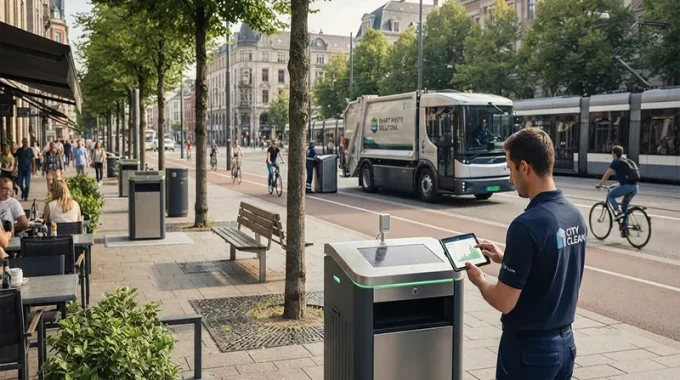
Modern cities face an unprecedented convergence of challenges: rapid global urbanization, tightening municipal operational budgets, and the ever-growing volume of public waste. Traditional waste collection methods—reliant on manual oversight and fixed schedules—are increasingly buckling under these pressures, often resulting in overflowing public receptacles, unsightly street litter, and bloated municipal expenditures.
As civic leaders race to build truly connected “smart cities,” a quiet technological revolution is transforming urban infrastructure from the ground up. At the forefront of this shift is the deployment of IoT smart bin sensors for municipal waste management technology. By turning ordinary waste containers into intelligent data nodes, these sensors empower city planners to replace guesswork with real-time intelligence, drastically cutting operational costs while elevating urban hygiene.
The Urban Waste Crisis: Why Traditional Collection Fails
For decades, municipal waste management has operated on a static, rigid framework. Sanitation trucks follow predetermined, fixed routes on set days of the week, emptying public bins whether they are completely full, half-empty, or completely empty.
This legacy approach is inherently inefficient. Sending heavy diesel trucks out to service empty containers wastes thousands of gallons of fuel, accelerates fleet wear-and-tear, contributes significantly to urban traffic congestion, and inflates municipal labor costs. Furthermore, high-traffic commercial zones or unexpected public events can cause bins to overflow hours before a scheduled collection, resulting in litter, health hazards, and citizen complaints. Traditional collection is reactive, expensive, and environmentally counterproductive.
How IoT Smart Bin Sensors Work
To solve these systemic inefficiencies, smart waste management relies on compact, ruggedized IoT devices retrofitted into existing or new bins. This technology stack comprises several core components:
1. Ultrasonic and Optical Fill-Level Sensors
Mounted inside the lid of the bin, these sensors use ultrasonic waves or optical technology to measure the volumetric fill-level of solid waste, recyclables, or organic compost at regular intervals. They account for varying pile configurations, ensuring accurate measurement regardless of what is tossed inside.
2. Cellular and LPWAN Connectivity
Once data is captured, it must be transmitted back to central municipal dashboards. Utilizing Low-Power Wide-Area Networks (such as LoRaWAN, NB-IoT, or 5G cellular connectivity), these sensors transmit telemetry packets efficiently while consuming minimal battery power, often operating for years on a single charge.
3. Integrated Safety and Environmental Telemetry
Modern smart bin sensors go beyond simple capacity tracking. Many models feature internal accelerometers and tilt sensors to detect container theft, vandalism, or unauthorized dumping. Integrated temperature sensors can also alert sanitation departments immediately to potential bin fires caused by discarded cigarettes or hot coals.
Key Benefits for Municipalities and City Planners
Integrating IoT fill-level sensors into a city’s waste infrastructure delivers transformative operational and environmental advantages:
- Dynamic Route Optimization: Rather than servicing every bin blindly, fleet managers use real-time sensor data to generate dynamic, demand-driven collection routes. Trucks are dispatched only to containers that have reached critical capacity thresholds. This can cut municipal fuel consumption and fleet wear-and-tear by up to 50 percent.
- Data-Driven Urban Planning: Historical fill-rate analytics provide deep insights into foot traffic and waste generation patterns across different neighborhoods. City planners can use this data to strategically reposition public bins, optimize container sizing, or scale up recycling infrastructure in high-density areas.
- Environmental and Public Health Impact: Eliminating container overflows prevents street litter from washing into storm drains, reduces urban carbon emissions through optimized routing, and significantly curtails pest attraction in public spaces.
Overcoming Implementation Challenges
While the benefits are clear, successful deployment requires careful consideration of practical hurdles. Municipalities must ensure that sensor hardware is rugged enough to withstand extreme weather fluctuations, vandalism, and corrosive waste environments. Additionally, seamless integration is vital: sensor data platforms must interface smoothly with existing municipal Geographic Information Systems (GIS) and fleet management software so that sanitation crews can adopt the new workflows without friction.
IoT smart bin sensors are no longer a futuristic concept reserved for experimental urban testbeds; they are an essential, high-ROI municipal utility upgrade for forward-thinking cities. By bridging the gap between physical infrastructure and real-time data analytics, these sensors enable urban centers to slash operational overhead, reduce their carbon footprint, and maintain pristine public spaces. Embracing smart waste technology is a vital step toward creating cleaner, more sustainable, and truly resilient cities for the future.